Living Myth
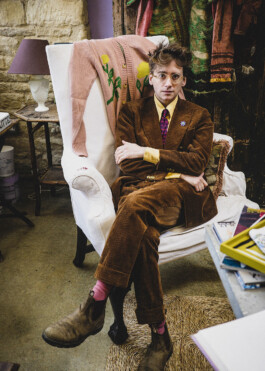
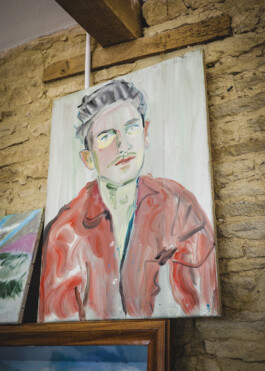
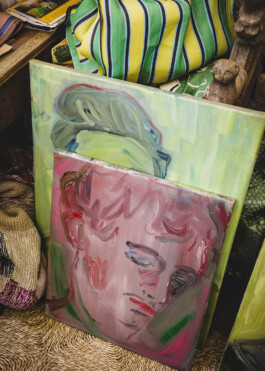
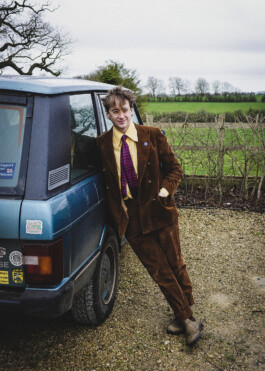
Luke Edward Hall builds worlds that feel both ancient and immediate – part mythology, part memory, part instinct. Moving fluidly between drawing, interiors and fashion, his work is rooted in storytelling, colour and romance, shaped as much by quiet moments in the countryside as by the rich visual histories he continues to revisit.


You grew up in Hampshire and later studied at Central Saint Martins. What were the earliest visual worlds that shaped your imagination?
I grew up in a very regular English town, and my first gateways into the worlds of art, fashion, music and culture were magazines – i-D, Dazed, Another. This was the mid-2000s, and they felt incredibly precious because they showed me what was happening in the city, and I couldn’t wait to get there. A magazine is how I learnt about Saint Martins, and by fifteen or sixteen I’d decided it was the only school I wanted to apply to.


“I want to make work that feels rooted, but completely alive.”
Your drawings often feel rooted in mythology and classical imagery. What continues to draw you to those historical references?
I’ve loved mythology since I was a child – I’ve always been captivated by fantastical universes, magic and the otherworldly. Perhaps that came from growing up in such a regular town. Mythology and folklore are still key influences in my work. Worlds like Ancient Greece or Arthurian legend are deep wells of romance and magic – portals into places that, even when populated by mythical beasts, still feel completely relevant today. As a queer man, I’ve also felt certain ancient stories reaching out across time – offering both solace and inspiration.


Italy appears often in your visual language. What does that place offer you creatively?
Italy is my favourite country to visit – I love the history, the art, the architecture, the food. I’m drawn to places that assault the senses, and Italy really does that. In Rome, or even more so in Naples, there’s beauty everywhere – but also total chaos. I like that tension between the two.
Your work collapses past and present in a very natural way. Do you consciously think about time when you’re making something?
Not consciously. I take so much inspiration from the past, but I never want to make nostalgic pastiche. I want the work to feel rooted, but completely alive.


Color is such a defining element of your work. Do your palettes emerge instinctively or through experimentation?
Through experimentation – playing with colour gives me a huge amount of joy. It’s a thread that runs through all of my projects. It does feel instinctive though. I don’t spend ages debating colours – whether it’s a wall or a jumper, I tend to go with my gut.
“My projects fit together like a tapestry – I’m building a kind of universe.”
You move between drawing, interiors, ceramics and fashion, including your own clothing line, Chateau Orlando. What does each medium allow you to explore creatively?
All of my projects fit together like pieces of a puzzle – or more like a tapestry. I’m exploring similar stories across them, building a kind of universe, but each medium lets me approach those ideas differently. That might be Cornish folklore through Chateau Orlando, or alpine flora and fauna for a hotel near Mont Blanc. Painting and drawing, though, feel the most pure – they’re total reflection. I feel the most freedom in the studio, just painting.


Designing interiors seems like extending your drawings into real space. How different does that process feel?
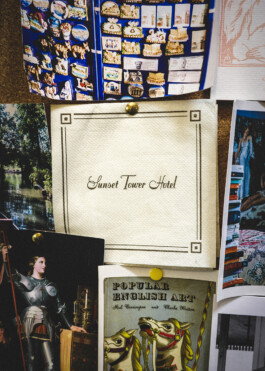
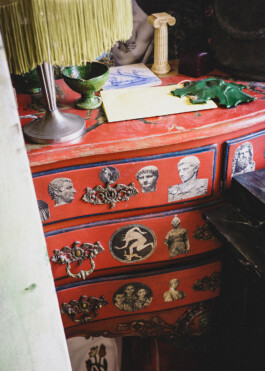
I love designing interiors for restaurants and hotels because I’m interested in building complete worlds. In those spaces, I can think about everything – carpets, wallpapers, stationery, music, even scent. A good hotel should transport you entirely – like stepping into another dimension.


I’ve heard you sometimes bid on things at auction and then forget about them until they suddenly arrive at the studio. What kinds of objects tend to follow you home that way?
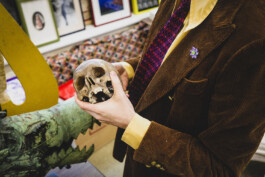
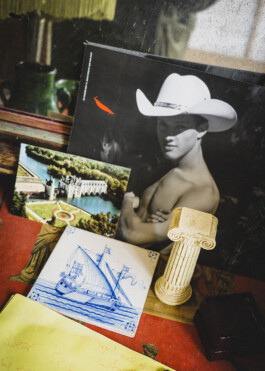
Oh, all sorts – it depends what I’m obsessed with at the time. Recently it was a set of five beautiful Whieldon plates from around 1760, with abstract green and brown decoration. I particularly love Whieldon. Before that, it was a piece of 18th-century theatre scenery.
Living in the countryside now, has your working rhythm changed?
I still work quite intensely – evenings, weekends – but living in the country forces me to stop as well. I have dogs, and I walk them once or twice a day. That time in nature is essential. I can step straight into fields and forests, really connect to the land and the seasons. That sense of connection feeds directly into my work.


“A good hotel should transport you entirely – like stepping into another dimension.”
What feels quietly on the horizon for you next?
I’m thinking about writing a book… maybe.
What book on your shelf have you returned to the most over the years?
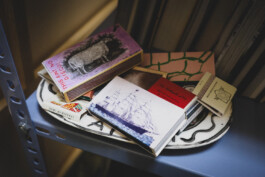
I come back to The Offing by Benjamin Myers every six months or so – the audiobook is wonderful. It captures an approach to life I try to hold onto. When I’m stressed, I think about Dulcie Piper – what would she say? It’s a book about living fully: art, poetry, good food, dogs, wine, nature, love.


Living Myth

Luke Edward Hall builds worlds that feel both ancient and immediate – part mythology, part memory, part instinct. Moving fluidly between drawing, interiors and fashion, his work is rooted in storytelling, colour and romance, shaped as much by quiet moments in the countryside as by the rich visual histories he continues to revisit.


You grew up in Hampshire and later studied at Central Saint Martins. What were the earliest visual worlds that shaped your imagination?
I grew up in a very regular English town, and my first gateways into the worlds of art, fashion, music and culture were magazines – i-D, Dazed, Another. This was the mid-2000s, and they felt incredibly precious because they showed me what was happening in the city, and I couldn’t wait to get there. A magazine is how I learnt about Saint Martins, and by fifteen or sixteen I’d decided it was the only school I wanted to apply to.


“I want to make work that feels rooted, but completely alive.”
Your drawings often feel rooted in mythology and classical imagery. What continues to draw you to those historical references?
I’ve loved mythology since I was a child – I’ve always been captivated by fantastical universes, magic and the otherworldly. Perhaps that came from growing up in such a regular town. Mythology and folklore are still key influences in my work. Worlds like Ancient Greece or Arthurian legend are deep wells of romance and magic – portals into places that, even when populated by mythical beasts, still feel completely relevant today. As a queer man, I’ve also felt certain ancient stories reaching out across time – offering both solace and inspiration.


Italy appears often in your visual language. What does that place offer you creatively?
Italy is my favourite country to visit – I love the history, the art, the architecture, the food. I’m drawn to places that assault the senses, and Italy really does that. In Rome, or even more so in Naples, there’s beauty everywhere – but also total chaos. I like that tension between the two.
Your work collapses past and present in a very natural way. Do you consciously think about time when you’re making something?
Not consciously. I take so much inspiration from the past, but I never want to make nostalgic pastiche. I want the work to feel rooted, but completely alive.


Color is such a defining element of your work. Do your palettes emerge instinctively or through experimentation?
Through experimentation – playing with colour gives me a huge amount of joy. It’s a thread that runs through all of my projects. It does feel instinctive though. I don’t spend ages debating colours – whether it’s a wall or a jumper, I tend to go with my gut.
“My projects fit together like a tapestry – I’m building a kind of universe.”
You move between drawing, interiors, ceramics and fashion, including your own clothing line, Chateau Orlando. What does each medium allow you to explore creatively?
All of my projects fit together like pieces of a puzzle – or more like a tapestry. I’m exploring similar stories across them, building a kind of universe, but each medium lets me approach those ideas differently. That might be Cornish folklore through Chateau Orlando, or alpine flora and fauna for a hotel near Mont Blanc. Painting and drawing, though, feel the most pure – they’re total reflection. I feel the most freedom in the studio, just painting.


Designing interiors seems like extending your drawings into real space. How different does that process feel?
I love designing interiors for restaurants and hotels because I’m interested in building complete worlds. In those spaces, I can think about everything – carpets, wallpapers, stationery, music, even scent. A good hotel should transport you entirely – like stepping into another dimension.


I’ve heard you sometimes bid on things at auction and then forget about them until they suddenly arrive at the studio. What kinds of objects tend to follow you home that way?
Oh, all sorts – it depends what I’m obsessed with at the time. Recently it was a set of five beautiful Whieldon plates from around 1760, with abstract green and brown decoration. I particularly love Whieldon. Before that, it was a piece of 18th-century theatre scenery.
Living in the countryside now, has your working rhythm changed?
I still work quite intensely – evenings, weekends – but living in the country forces me to stop as well. I have dogs, and I walk them once or twice a day. That time in nature is essential. I can step straight into fields and forests, really connect to the land and the seasons. That sense of connection feeds directly into my work.


“A good hotel should transport you entirely – like stepping into another dimension.”
What feels quietly on the horizon for you next?
I’m thinking about writing a book… maybe.
What book on your shelf have you returned to the most over the years?
I come back to The Offing by Benjamin Myers every six months or so – the audiobook is wonderful. It captures an approach to life I try to hold onto. When I’m stressed, I think about Dulcie Piper – what would she say? It’s a book about living fully: art, poetry, good food, dogs, wine, nature, love.