Engineered Flow
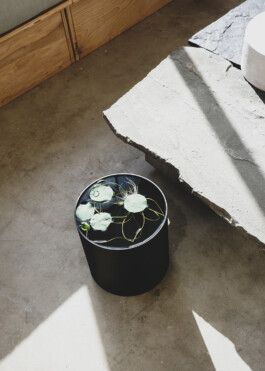
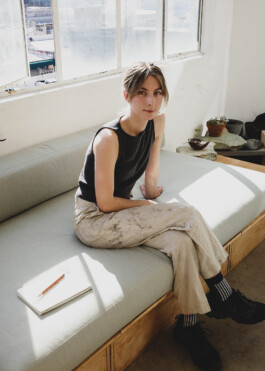
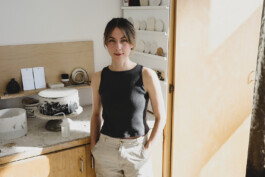
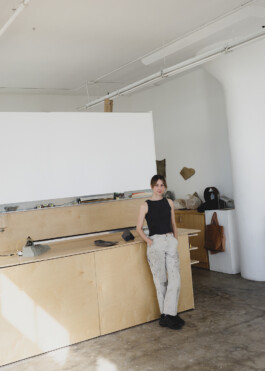
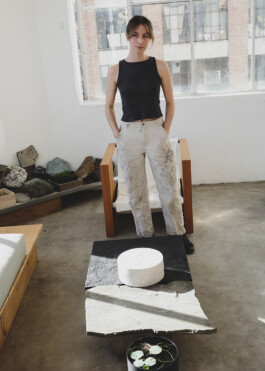
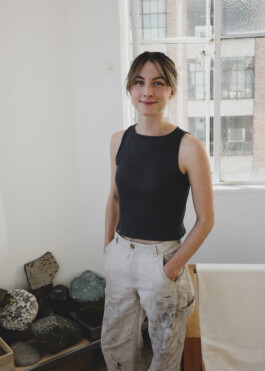
Lily Clark makes water behave like a drawing tool – but one with a mind of its own. From MICA to New York to Los Angeles, her practice moves between precision and drift, hidden mechanisms and pure perception. Light, shadow, stone, mist – and an infrastructure obsession – shape every decision.


You studied graphic design at MICA and later moved through New York before landing in Los Angeles. Looking back, what did those early chapters give you?
Those years in Baltimore and New York gave me tools to think through the bigger picture, but also very practical skills like quickly putting together a client deck or rebuilding my website. What I learned during those years, I use every day while running a studio. Back then, I was also spending a lot of my time making sculptural objects. I was 3D-printing components and tools for ceramics, airbrushing, working with basic robotics, and dabbling in product design. While at school, I began working with water for the first time and noticed how effectively it expressed light and shadow. It felt familiar and overlooked at the same time, especially in terms of its phenomenological qualities. I was hooked then, and water has been the focus of my practice since.


Was there a moment—at school or in New York—when you realized the work you wanted to make couldn’t stay on the page?
Probably during my freshman year of college. I started moving away from strictly two-dimensional work and found myself reworking design assignments so the process involved CNC machining, 3D printing, or clay. By my senior year, my thesis was closer to sculpture and robotics than anything page-based. A major influence at the time was Tauba Auerbach. Her ability to move seamlessly between two and three dimensions sparked my interest in mathematics and physics, which eventually led me directly to working with water.


“Standing below a massive concrete wall holding back tens of billions of gallons of water, it’s impossible not to think about the long history of human trial and error behind it.”


Japanese aesthetics and materials seem to quietly echo through your work. What first drew you to that way of thinking and making?
That’s a high compliment. Growing up in Los Angeles, surrounded by modernist architecture, I was likely absorbing a translated version of Japanese aesthetics without realizing it. Through the work of Schindler, Neutra, and Frank Lloyd Wright, I became sensitive to natural light, shadow, and the relationship between built space and nature. The impact of that environment didn’t fully register until I moved to New York and began to notice the differences between the two cities, especially the quality of light and how it’s handled.
Visiting Japan in my early twenties fundamentally shifted how I think about materials as they age. On my second trip, encountering mossy, aged stone water features reframed my approach, moving away from trying to control a material and toward working with its inherent qualities.


Growing up in Los Angeles, surrounded by reservoirs, aqueducts, and engineered landscapes, how did that environment shape your sensitivity to flow and control?
The Los Angeles water story has fascinated me for years, especially as a multi-generational Angeleno. The infrastructure feels remarkably close to the present. The Aqueduct is only 113 years old, yet this history is often overlooked. I spend a lot of time visiting sites connected to it, from the ruins of the St. Francis Dam to the dry, and at times drivable, bed of Owens Lake.
In these places where water, infrastructure, and landscape meet, I’m struck by a mix of awe and unease. Standing below a massive concrete wall holding back tens of billions of gallons of water, it’s impossible not to think about the long history of human trial and error behind it. Built on millennia of accumulated knowledge, this infrastructure is part of a continuous lineage, and it prompts me to consider how my own work might contribute to the built world.
“Each droplet seemed to hold the painted ‘shadow,’ even after the water evaporated.”


Water sits at the center of your practice, even when it’s barely visible. When did you start thinking of it as a material rather than a metaphor?
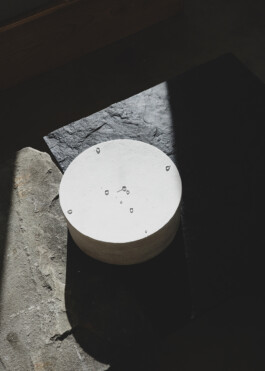
I started working directly with water about 10 years ago. At the time, I had just seen the James Turrell retrospective at LACMA and was deeply interested in the Light and Space movement in Los Angeles during the early 1970s. I was experimenting with ways to capture light and had just bought my first airbrush that summer. I began a series of what I called “raking light” experiments, spraying black and white pigment directionally at a low angle to reveal surface texture.
One day, I carefully placed a few droplets of water onto the page and airbrushed black pigment at a low angle. Each droplet seemed to hold the painted “shadow,” even after the water evaporated. From that moment on, I was drawn to water and its ability to register light. It’s an immediately responsive material, sensitive to even the smallest input, and I see a lifetime of work in engaging with it directly as a material rather than as a metaphor.


How do you source the materials you work with—stone, clay, metal—and how much does place influence those decisions?
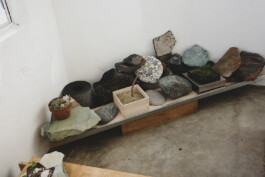
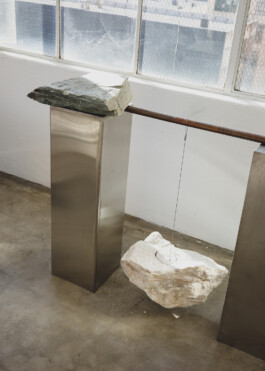
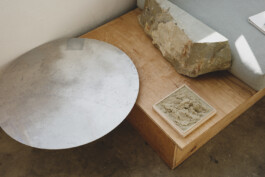
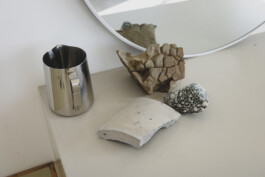
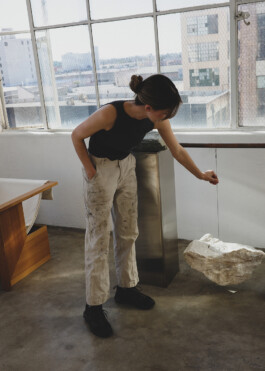
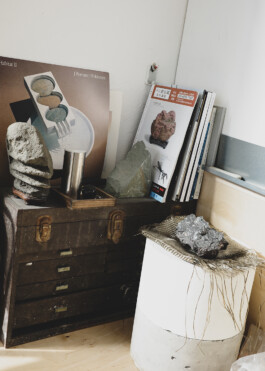
Most of the stones I work with come from local quarries and stone suppliers. Los Angeles is an ideal place to work because it sits at the center of so much material circulation. For my upcoming show at Ghebaly, I sourced an asymmetrical dolomite boulder from a recently closed quarry next to Owens Lake, which felt like a special homage to this LA water story I mentioned.
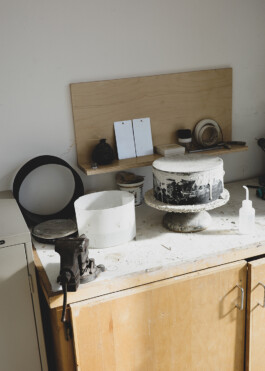
But it’s when I’m traveling and making work that specific places have the most influence on my decision-making. I’ve participated in a handful of residencies, and I always try to work with an unfamiliar local material: in Greece, I worked with white marble; in Japan, I worked with copper and straw; and in upstate New York, I worked with lichenous bluestone.


Your work balances precision with chance. How do you know when to intervene and when to let a system behave on its own?
Most of the time I feel like I’m working at the behest of water. It wants to do what it wants to do, and my role is to identify the specific levers that guide it. I’ve been working with ultrasonic mist recently, which has taught me a lot about speed. Fluid dynamics become accelerated, making wind visible as gases intermix. Eddies and wave behaviors appear quickly and clearly. Right now, I’m attempting to design an enclosure to keep the fog as still as possible.
Many of your pieces rely on hidden mechanisms. What role does invisibility play in how you want the work to be experienced?
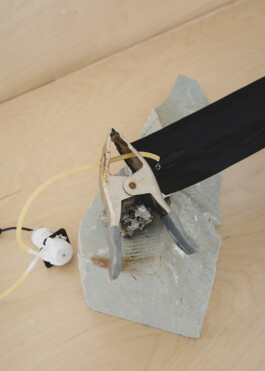
When mechanisms disappear, attention shifts away from how something functions and toward how it alters perception. The absence of visible pumps, tubing, etc. allows the viewer to stay with the experience itself, with the water as the primary material.
“At most major dams in Japan, they will usually have collectible cards, a museum, a mascot, and a restaurant selling a special dam curry dish.”


When something fails or behaves unexpectedly, does that feel like a setback—or the work showing you where to go next?
Mistakes make up most of my process, and I usually take that as a sign I’m moving in the right direction. Water responds so immediately to its environment and is constantly giving me design feedback. Watching it, trying to anticipate what it’ll do next, and always being surprised is what I love most about the process. It only feels like a setback when expectations are placed ahead of the medium.
Right now, what materials are intriguing you most?
(Besides water and its many forms) I also can’t stop thinking about:
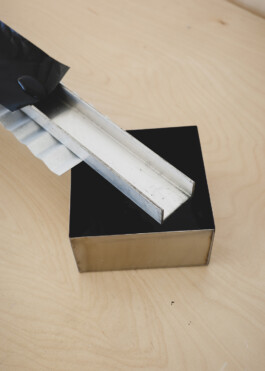
Galvanized steel
Obsidian
Tempered glass
Moss


What are a few things you love most about Japan—whether it’s materials, places, rituals, or just ways of seeing?
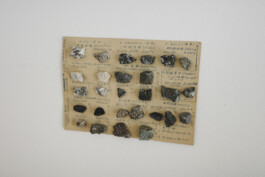
Probably the culture around their water infrastructure. At most major dams in Japan, they will usually have collectible cards, a museum, a mascot, and a restaurant selling a special dam curry dish with rice packed as an embankment for the liquid. One day I’ll make a trip to Japan centered around the dam tourism, timing it with the overflow release dates.

Engineered Flow

Lily Clark makes water behave like a drawing tool – but one with a mind of its own. From MICA to New York to Los Angeles, her practice moves between precision and drift, hidden mechanisms and pure perception. Light, shadow, stone, mist – and an infrastructure obsession – shape every decision.


You studied graphic design at MICA and later moved through New York before landing in Los Angeles. Looking back, what did those early chapters give you?
Those years in Baltimore and New York gave me tools to think through the bigger picture, but also very practical skills like quickly putting together a client deck or rebuilding my website. What I learned during those years, I use every day while running a studio. Back then, I was also spending a lot of my time making sculptural objects. I was 3D-printing components and tools for ceramics, airbrushing, working with basic robotics, and dabbling in product design. While at school, I began working with water for the first time and noticed how effectively it expressed light and shadow. It felt familiar and overlooked at the same time, especially in terms of its phenomenological qualities. I was hooked then, and water has been the focus of my practice since.


Was there a moment—at school or in New York—when you realized the work you wanted to make couldn’t stay on the page?
Probably during my freshman year of college. I started moving away from strictly two-dimensional work and found myself reworking design assignments so the process involved CNC machining, 3D printing, or clay. By my senior year, my thesis was closer to sculpture and robotics than anything page-based. A major influence at the time was Tauba Auerbach. Her ability to move seamlessly between two and three dimensions sparked my interest in mathematics and physics, which eventually led me directly to working with water.


“Standing below a massive concrete wall holding back tens of billions of gallons of water, it’s impossible not to think about the long history of human trial and error behind it.”


Japanese aesthetics and materials seem to quietly echo through your work. What first drew you to that way of thinking and making?
That’s a high compliment. Growing up in Los Angeles, surrounded by modernist architecture, I was likely absorbing a translated version of Japanese aesthetics without realizing it. Through the work of Schindler, Neutra, and Frank Lloyd Wright, I became sensitive to natural light, shadow, and the relationship between built space and nature. The impact of that environment didn’t fully register until I moved to New York and began to notice the differences between the two cities, especially the quality of light and how it’s handled.
Visiting Japan in my early twenties fundamentally shifted how I think about materials as they age. On my second trip, encountering mossy, aged stone water features reframed my approach, moving away from trying to control a material and toward working with its inherent qualities.


Growing up in Los Angeles, surrounded by reservoirs, aqueducts, and engineered landscapes, how did that environment shape your sensitivity to flow and control?
The Los Angeles water story has fascinated me for years, especially as a multi-generational Angeleno. The infrastructure feels remarkably close to the present. The Aqueduct is only 113 years old, yet this history is often overlooked. I spend a lot of time visiting sites connected to it, from the ruins of the St. Francis Dam to the dry, and at times drivable, bed of Owens Lake.
In these places where water, infrastructure, and landscape meet, I’m struck by a mix of awe and unease. Standing below a massive concrete wall holding back tens of billions of gallons of water, it’s impossible not to think about the long history of human trial and error behind it. Built on millennia of accumulated knowledge, this infrastructure is part of a continuous lineage, and it prompts me to consider how my own work might contribute to the built world.
“Each droplet seemed to hold the painted ‘shadow,’ even after the water evaporated.”


Water sits at the center of your practice, even when it’s barely visible. When did you start thinking of it as a material rather than a metaphor?
I started working directly with water about 10 years ago. At the time, I had just seen the James Turrell retrospective at LACMA and was deeply interested in the Light and Space movement in Los Angeles during the early 1970s. I was experimenting with ways to capture light and had just bought my first airbrush that summer. I began a series of what I called “raking light” experiments, spraying black and white pigment directionally at a low angle to reveal surface texture.
One day, I carefully placed a few droplets of water onto the page and airbrushed black pigment at a low angle. Each droplet seemed to hold the painted “shadow,” even after the water evaporated. From that moment on, I was drawn to water and its ability to register light. It’s an immediately responsive material, sensitive to even the smallest input, and I see a lifetime of work in engaging with it directly as a material rather than as a metaphor.

How do you source the materials you work with—stone, clay, metal—and how much does place influence those decisions?
Most of the stones I work with come from local quarries and stone suppliers. Los Angeles is an ideal place to work because it sits at the center of so much material circulation. For my upcoming show at Ghebaly, I sourced an asymmetrical dolomite boulder from a recently closed quarry next to Owens Lake, which felt like a special homage to this LA water story I mentioned.
But it’s when I’m traveling and making work that specific places have the most influence on my decision-making. I’ve participated in a handful of residencies, and I always try to work with an unfamiliar local material: in Greece, I worked with white marble; in Japan, I worked with copper and straw; and in upstate New York, I worked with lichenous bluestone.


Your work balances precision with chance. How do you know when to intervene and when to let a system behave on its own?
Most of the time I feel like I’m working at the behest of water. It wants to do what it wants to do, and my role is to identify the specific levers that guide it. I’ve been working with ultrasonic mist recently, which has taught me a lot about speed. Fluid dynamics become accelerated, making wind visible as gases intermix. Eddies and wave behaviors appear quickly and clearly. Right now, I’m attempting to design an enclosure to keep the fog as still as possible.
Many of your pieces rely on hidden mechanisms. What role does invisibility play in how you want the work to be experienced?
When mechanisms disappear, attention shifts away from how something functions and toward how it alters perception. The absence of visible pumps, tubing, etc. allows the viewer to stay with the experience itself, with the water as the primary material.
“At most major dams in Japan, they will usually have collectible cards, a museum, a mascot, and a restaurant selling a special dam curry dish.”


When something fails or behaves unexpectedly, does that feel like a setback—or the work showing you where to go next?
Mistakes make up most of my process, and I usually take that as a sign I’m moving in the right direction. Water responds so immediately to its environment and is constantly giving me design feedback. Watching it, trying to anticipate what it’ll do next, and always being surprised is what I love most about the process. It only feels like a setback when expectations are placed ahead of the medium.
Right now, what materials are intriguing you most?
(Besides water and its many forms) I also can’t stop thinking about:
Galvanized steel
Obsidian
Tempered glass
Moss


What are a few things you love most about Japan—whether it’s materials, places, rituals, or just ways of seeing?
Probably the culture around their water infrastructure. At most major dams in Japan, they will usually have collectible cards, a museum, a mascot, and a restaurant selling a special dam curry dish with rice packed as an embankment for the liquid. One day I’ll make a trip to Japan centered around the dam tourism, timing it with the overflow release dates.