Lo Frequency
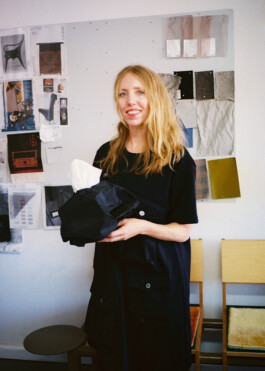
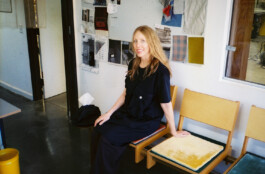
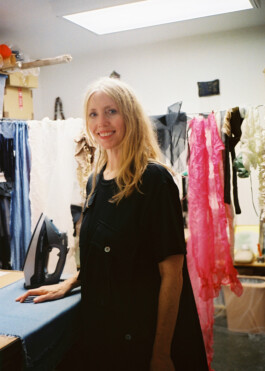
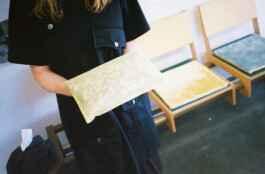
Kristin Dickson-Okuda makes things that care. Pillows that aren’t really for resting on, furniture dressed in clothing language, objects that honor the accidental and the ordinary. Between LA, Japan, and the return of Iko Iko, she’s building a practice as fluid and precise as the instinct that drives it.


You grew up in Texas and ended up in LA via Japan. How did that journey shape the way you see objects and spaces?
I wanted to leave Austin and try university in an environment different from my home. I went to school in Boston, then dreamed of California and the light and space. Los Angeles offers so many perspectives. Its loneliness can force you to work harder, search deeper. That’s what I needed when I first arrived – to meander and refine. Having my space led me to Shin and then to Japan.
“Its loneliness can force you to work harder, search deeper. That’s what I needed when I first arrived — to meander and refine.”


What has Japan given your practice that you couldn’t have found anywhere else?
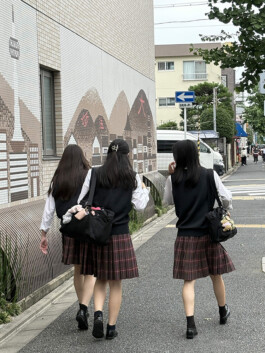
I enjoy discovering the reasoning for things – the spirituality of objects, colors, nature, the cultural explanations and social mores of Japan. The time I get to spend with Shin in his family element is very incredible. Also being with Issei as he navigates school life is quite instructive. Learning a language and a culture as an adult is very humbling. I’m inspired by the many elements of surprise I have day to day when I’m in Japan.


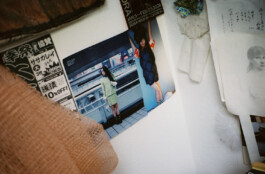
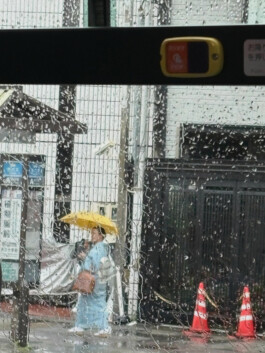
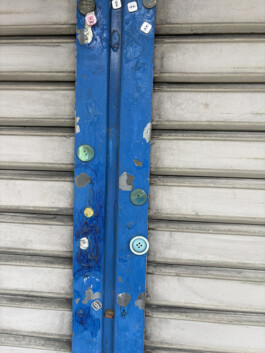
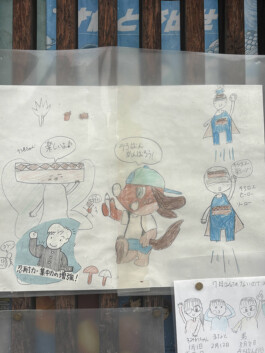
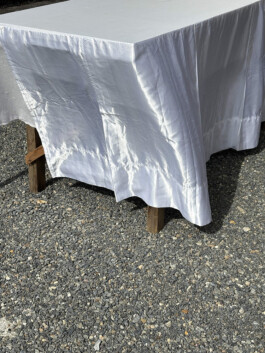
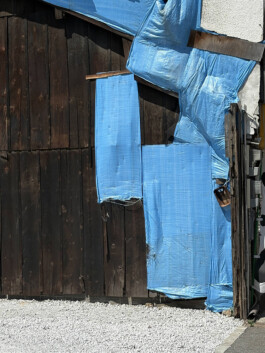
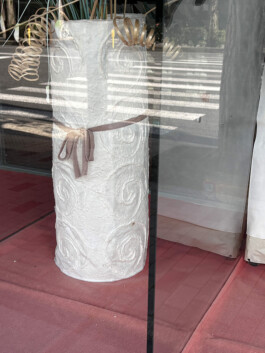
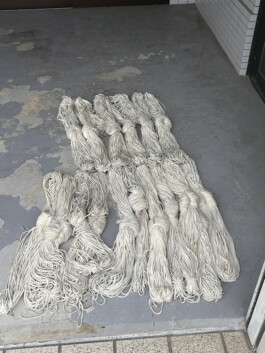
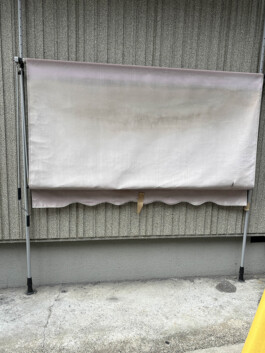
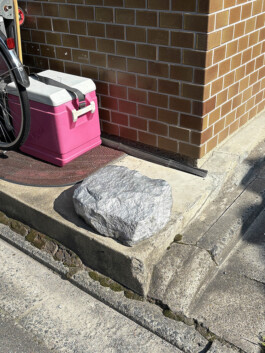
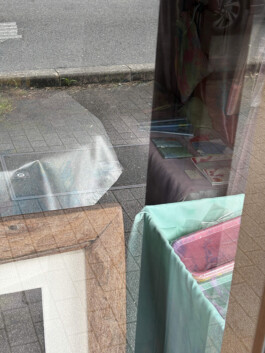
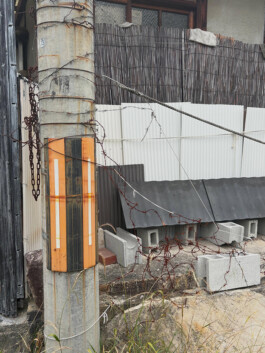
Shin’s mom’s friends laugh at you for photographing ordinary things – a hose, a garbage net. What are you actually seeing that they’re not?
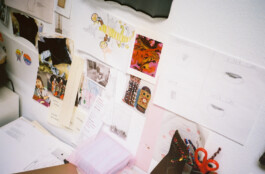
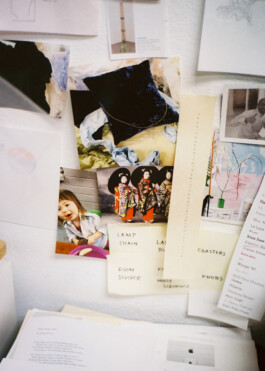
Delight! I approach these photos as idea prompts for me. They function as research in a way, but also as a recognition – an honoring of casual beauty, daily ingenuity, and often humor. It’s very nonchalant, lo-frequency beauty. I am looking for starters, cues, unusual solutions that people create in and around their space. It’s how I record my memories in Japan and elsewhere – really just a way of seeing.


When did you know it was time to stop making clothes – and how did it feel to actually let that go?
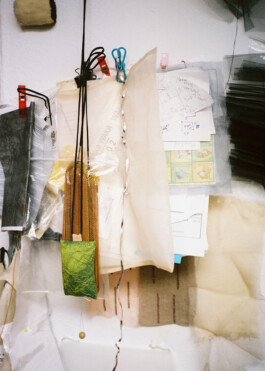
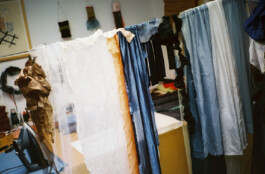
Perhaps I just shifted where I placed the clothing. I still think in the vocabulary of clothing and forming fabric forms over volumes. I still love clothing as an expression, but I don’t feel inspired to make clothing as my one expression. It was a letting go in order to grow and develop as a maker. I rely on my intuition and that was the message.
You use the word “care” a lot – covering, protecting, softening, uplifting. Where did that instinct come from?
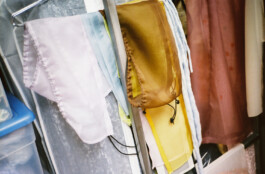
I think making things is an act of love and joy. I find many emotions in colors and textures, and in appropriating them to the concept I have in mind. I make pieces for people to use and interpret in their day to day life. I want there to be a generosity, and I like that people could use my work as a form of care – caring for one’s space, the objects one uses, and of course caring for one’s self.

“I want there to be a generosity, and I like that people could use my work as a form of care.”

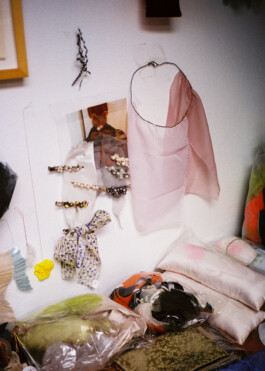
Clothing language applied to furniture – garters, tendrils, cozies, wraps. Does the language come before the object or after?
After. I like to think of alternative solutions or ways of engaging with objects. The language is a result of the clothing vocabulary I often draw from.


Iko Iko is coming back – what’s different this time?
I think it will feel like a very specific entrance point to what I collect, make, and how they co-exist as me, now. I am trying to reinterpret these objects with things I make. The objects I show are a choice, a selection, and are very finite – reflecting time I’ve spent in a certain place and what I find interesting to share. It does circle back to the impulse behind my photos. I want this to be a full circle of seeing.
The space will also be in a structure Shin is making. It’s a continuation of his tea room construction and will hopefully feel like you’re entering a little portal of curiosities.

Shin’s furniture and your soft objects are in constant conversation. What does it feel like when that collaboration really clicks?
It is our language together. I feel very lucky. Shin is so generous in the space he gives me to make my ideas. Every day is a collaboration, so it’s an every day connection. I can lead with something abstract and he brings it to earth in a gentle and intelligent way.
When does an object earn the word “beautiful” from you?
In so many forms – but maybe my favorite is in a very casual, accidental way, like amazing cloud formations, or finding a perfectly twisted stick, a worn doll’s dress. The transformation is when I can incorporate those observations into an element of my work – be it a specific line quality, a beading idea, a structural detail for a pillow, even a personal memory. I like a deep sense of wonder, making something mysterious, obscuring the function a bit. That can make a piece very beautiful to me.
“I can lead with something abstract and he brings it to earth in a gentle and intelligent way.”


What does a good day in the studio look like right now?
When I have extended time. Time! I like when the workflow can allow for ample experiment time and things can arrive at a new place.
Five things: a place that’s still yours, a hidden gem, what’s keeping you going, what still surprises you, what you can’t live without.
Reading a book before bed – that before-rest comfort a book can feed.
Ascot Hills Park, a low-impact hiking park in our neighborhood.
Ideas and making work.
Releasing ego and expectations – in parenting, in creating, in relationships of all kinds.
Shin, Issei, family, and good tortilla chips.

Lo Frequency

Kristin Dickson-Okuda makes things that care. Pillows that aren’t really for resting on, furniture dressed in clothing language, objects that honor the accidental and the ordinary. Between LA, Japan, and the return of Iko Iko, she’s building a practice as fluid and precise as the instinct that drives it.


You grew up in Texas and ended up in LA via Japan. How did that journey shape the way you see objects and spaces?
I wanted to leave Austin and try university in an environment different from my home. I went to school in Boston, then dreamed of California and the light and space. Los Angeles offers so many perspectives. Its loneliness can force you to work harder, search deeper. That’s what I needed when I first arrived – to meander and refine. Having my space led me to Shin and then to Japan.
“Its loneliness can force you to work harder, search deeper. That’s what I needed when I first arrived — to meander and refine.”


What has Japan given your practice that you couldn’t have found anywhere else?
I enjoy discovering the reasoning for things – the spirituality of objects, colors, nature, the cultural explanations and social mores of Japan. The time I get to spend with Shin in his family element is very incredible. Also being with Issei as he navigates school life is quite instructive. Learning a language and a culture as an adult is very humbling. I’m inspired by the many elements of surprise I have day to day when I’m in Japan.


Shin’s mom’s friends laugh at you for photographing ordinary things – a hose, a garbage net. What are you actually seeing that they’re not?
Delight! I approach these photos as idea prompts for me. They function as research in a way, but also as a recognition – an honoring of casual beauty, daily ingenuity, and often humor. It’s very nonchalant, lo-frequency beauty. I am looking for starters, cues, unusual solutions that people create in and around their space. It’s how I record my memories in Japan and elsewhere – really just a way of seeing.


When did you know it was time to stop making clothes – and how did it feel to actually let that go?
Perhaps I just shifted where I placed the clothing. I still think in the vocabulary of clothing and forming fabric forms over volumes. I still love clothing as an expression, but I don’t feel inspired to make clothing as my one expression. It was a letting go in order to grow and develop as a maker. I rely on my intuition and that was the message.
You use the word “care” a lot – covering, protecting, softening, uplifting. Where did that instinct come from?
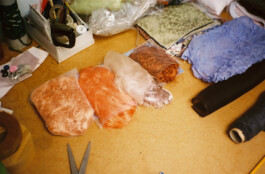
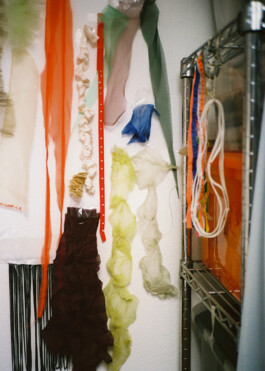
I think making things is an act of love and joy. I find many emotions in colors and textures, and in appropriating them to the concept I have in mind. I make pieces for people to use and interpret in their day to day life. I want there to be a generosity, and I like that people could use my work as a form of care – caring for one’s space, the objects one uses, and of course caring for one’s self.

“I want there to be a generosity, and I like that people could use my work as a form of care.”

Clothing language applied to furniture – garters, tendrils, cozies, wraps. Does the language come before the object or after?
After. I like to think of alternative solutions or ways of engaging with objects. The language is a result of the clothing vocabulary I often draw from.


Iko Iko is coming back – what’s different this time?
I think it will feel like a very specific entrance point to what I collect, make, and how they co-exist as me, now. I am trying to reinterpret these objects with things I make. The objects I show are a choice, a selection, and are very finite – reflecting time I’ve spent in a certain place and what I find interesting to share. It does circle back to the impulse behind my photos. I want this to be a full circle of seeing.
The space will also be in a structure Shin is making. It’s a continuation of his tea room construction and will hopefully feel like you’re entering a little portal of curiosities.

Shin’s furniture and your soft objects are in constant conversation. What does it feel like when that collaboration really clicks?
It is our language together. I feel very lucky. Shin is so generous in the space he gives me to make my ideas. Every day is a collaboration, so it’s an every day connection. I can lead with something abstract and he brings it to earth in a gentle and intelligent way.
When does an object earn the word “beautiful” from you?
In so many forms – but maybe my favorite is in a very casual, accidental way, like amazing cloud formations, or finding a perfectly twisted stick, a worn doll’s dress. The transformation is when I can incorporate those observations into an element of my work – be it a specific line quality, a beading idea, a structural detail for a pillow, even a personal memory. I like a deep sense of wonder, making something mysterious, obscuring the function a bit. That can make a piece very beautiful to me.
“I can lead with something abstract and he brings it to earth in a gentle and intelligent way.”


What does a good day in the studio look like right now?
When I have extended time. Time! I like when the workflow can allow for ample experiment time and things can arrive at a new place.
Five things: a place that’s still yours, a hidden gem, what’s keeping you going, what still surprises you, what you can’t live without.
Reading a book before bed – that before-rest comfort a book can feed.
Ascot Hills Park, a low-impact hiking park in our neighborhood.
Ideas and making work.
Releasing ego and expectations – in parenting, in creating, in relationships of all kinds.
Shin, Issei, family, and good tortilla chips.